This morning, the Texas Education Agency released results from the spring 2026 STAAR assessments for grades 3 through 8. Statewide math scores were the best result since before the pandemic, reading scores held at their highest level since at least 2019, and social studies scores improved. These assessments are the state’s most consistent measure of whether students are building foundational knowledge and skills that support future success. There is real progress in these results, however small. There is also the reality that too many students are struggling to perform at grade level. Fewer than half of Texas students are on grade level in math and more than 4 in 10 students are reading below grade level. This year’s results set the baseline against which the Legislature’s newest investments in public education, just now reaching classrooms, will be measured.
Key Takeaways
- Math scores rose 1 point to 43 percent of students meeting grade level, the strongest result since before the pandemic and a second consecutive year of gains, though still 5 points below 2019.
- Fourth grade math results jumped 4 points to 49 percent of students performing on grade level, marking the first time that any grades 3-8 math results have climbed above pre-COVID levels. Seventh grade math scores slipped to 29 percent of students meeting grade level, a dip explained in part by the growth of advanced math pathways that move top students to take the grade 8 test a year early.
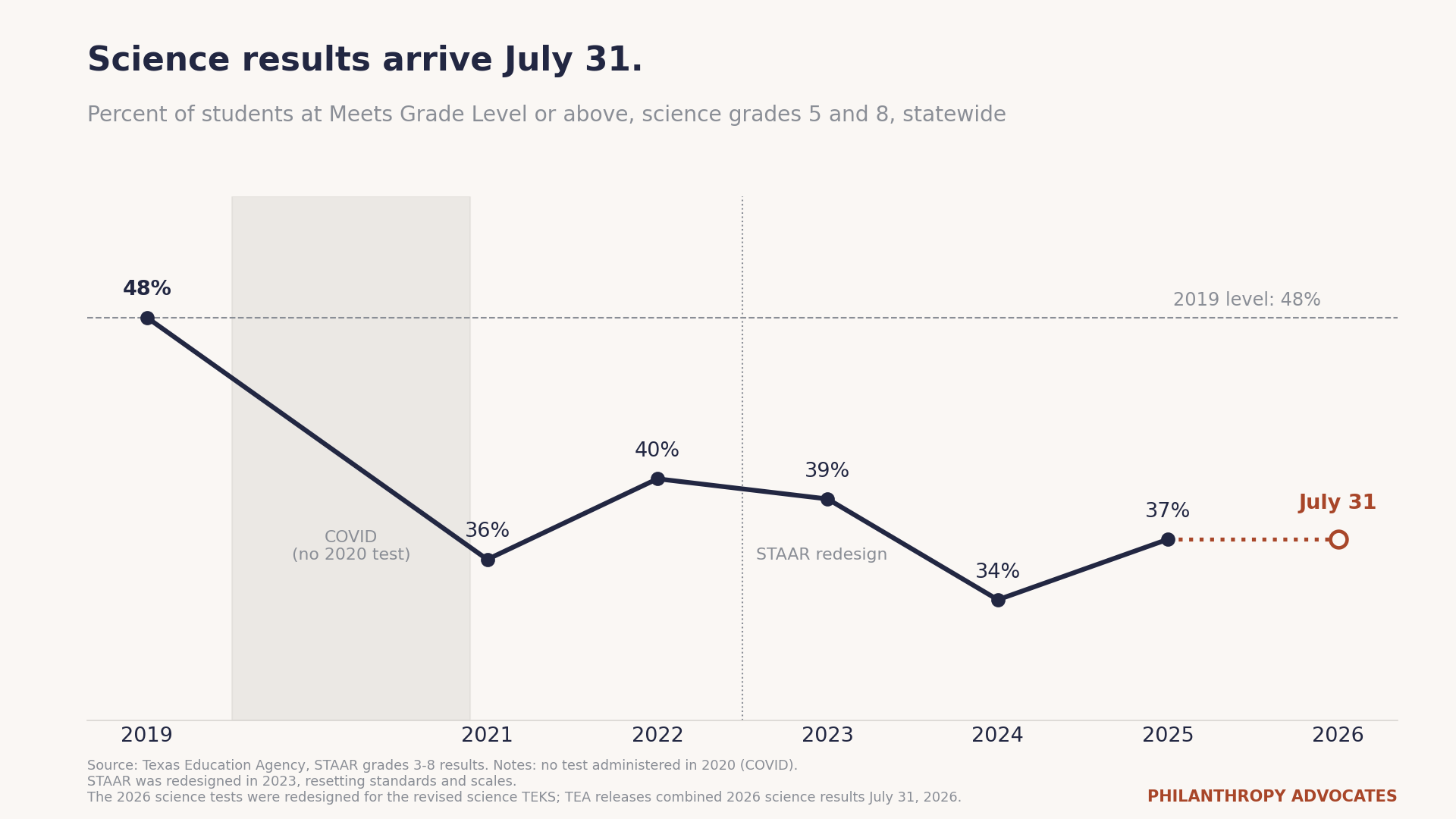
- Reading scores held at 54 percent of students performing on grade level, the highest level since at least 2019 and 9 points above pre-COVID performance, though the grades moved in different directions: eighth grade set a new high at 59 percent while third grade slipped a point to 49.
- Economically disadvantaged students reached a new reading high at 43 percent meeting grade level, and Hispanic (48 percent) and African American (44 percent) students posted their best reading results since at least 2019.
- With House Bill 2’s investments in teacher preparation, teacher retention, early literacy, and numeracy just beginning to reach classrooms in the next two years, 2026 is the baseline year for measuring what comes next.
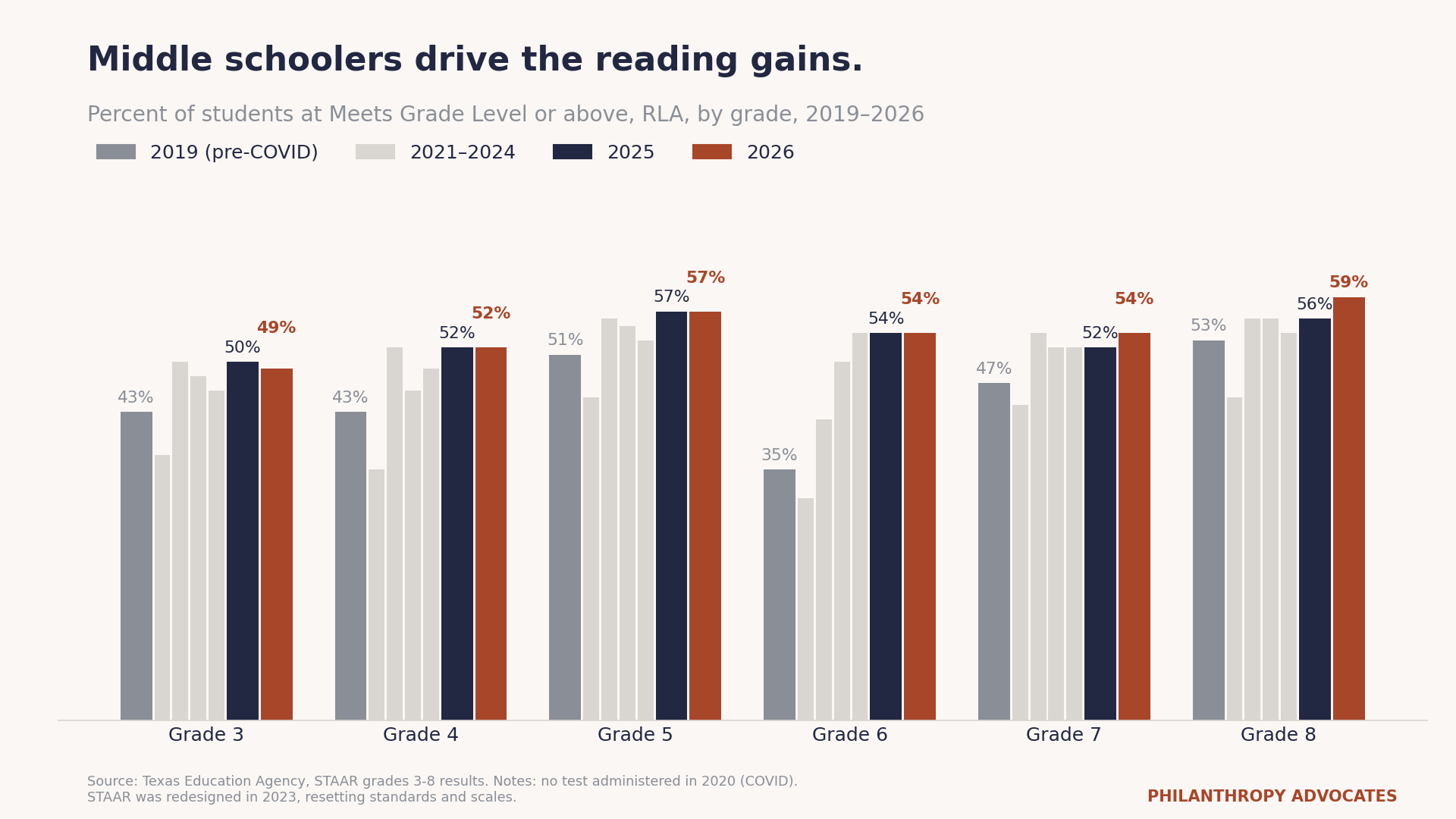
- Science results arrive July 31, slightly later because TEA is completing the standard setting process for the newly redesigned tests.
The results at a glance
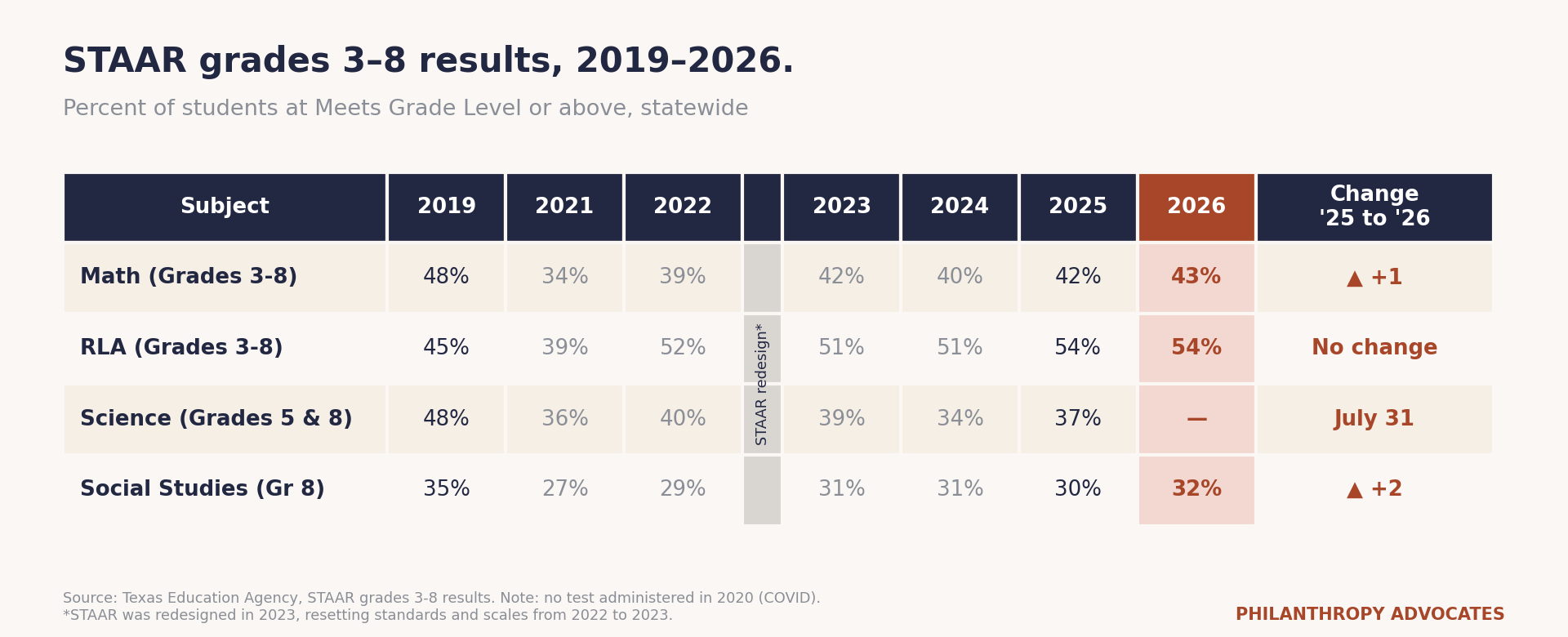
Three things stand out. Math results were the strongest statewide result since before the pandemic and have gained ground two years in a row. Reading scores held at the highest level since at least 2019, nine points above where Texas stood before COVID. And this year’s release is incomplete by design: because TEA is completing the standard setting process for the newly redesigned science assessments, science results will not arrive until July 31. Results also vary widely by grade and subject, and the sections below flag where numbers moved in both directions. One note on terms: throughout this piece we report the share of students at Meets Grade Level, the standard that signals a student is truly on grade level and prepared for the next one, rather than Approaches, which is the passing standard.
Strongest math results since the pandemic
Forty-three percent of students in grades 3 through 8 met grade level in math this year, up 1 point from 2025 and the strongest statewide result since 2019. Math results fell harder than any other subject during the pandemic, dropping from 48 percent to 34 percent, and have taken the longest to rebuild. That leaves math results 5 percentage points short of pre-COVID levels but moving in the right direction for a second straight year. It also leaves more than half of Texas students below grade level in math, a gap the state cannot accept as the new normal.
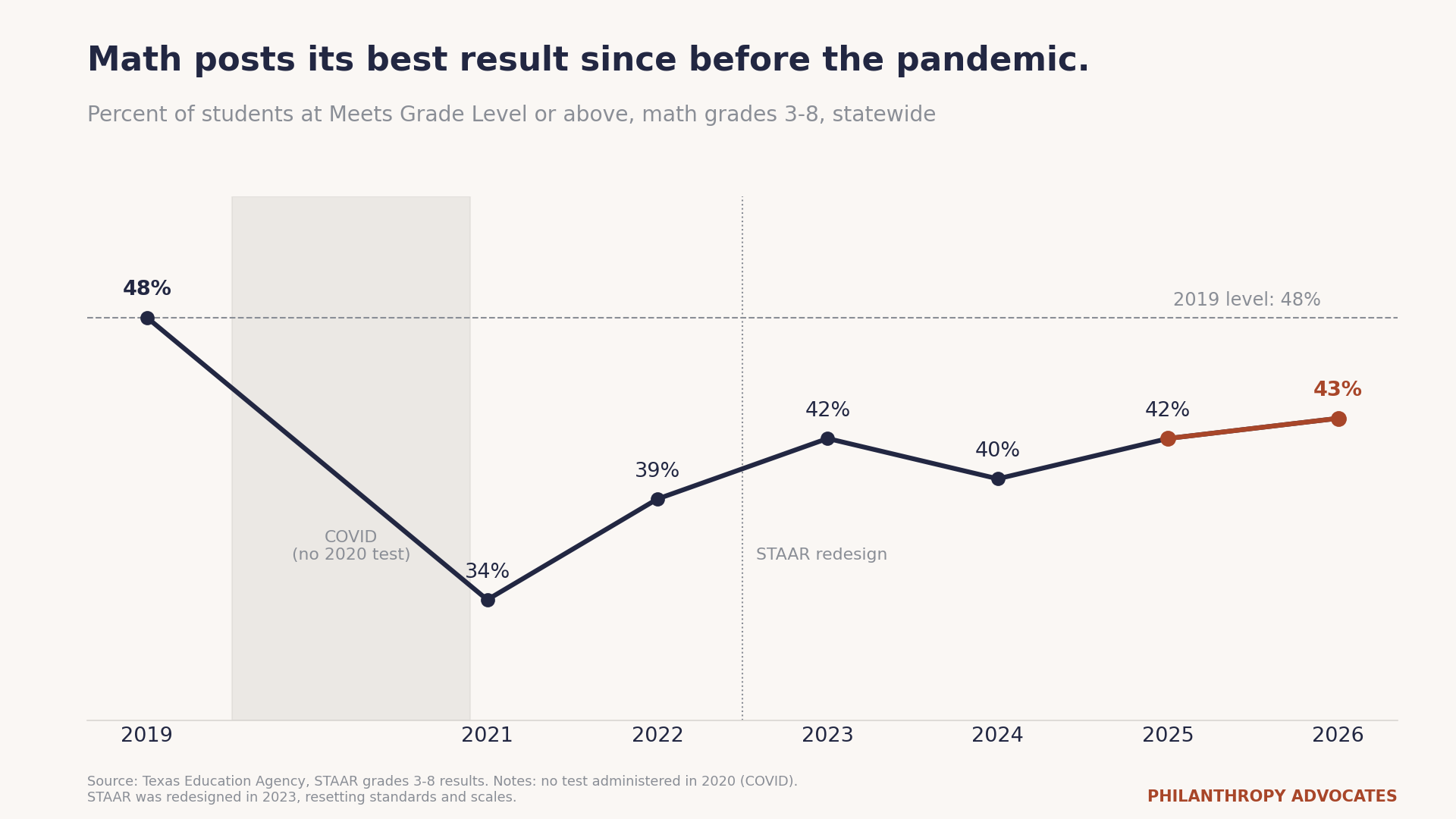
The grade-level numbers split sharply. Fourth grade is the bright spot: up 4 points to 49 percent, this represents the first grades 3-8 math results to climb above pre-COVID levels. Grades 5 and 8 each gained 2 points to reach 47 percent, and grade 6 ticked up to 39. Seventh grade fell 2 points to 29 percent, the only grade to decline and now 12 points below its 2019 level.
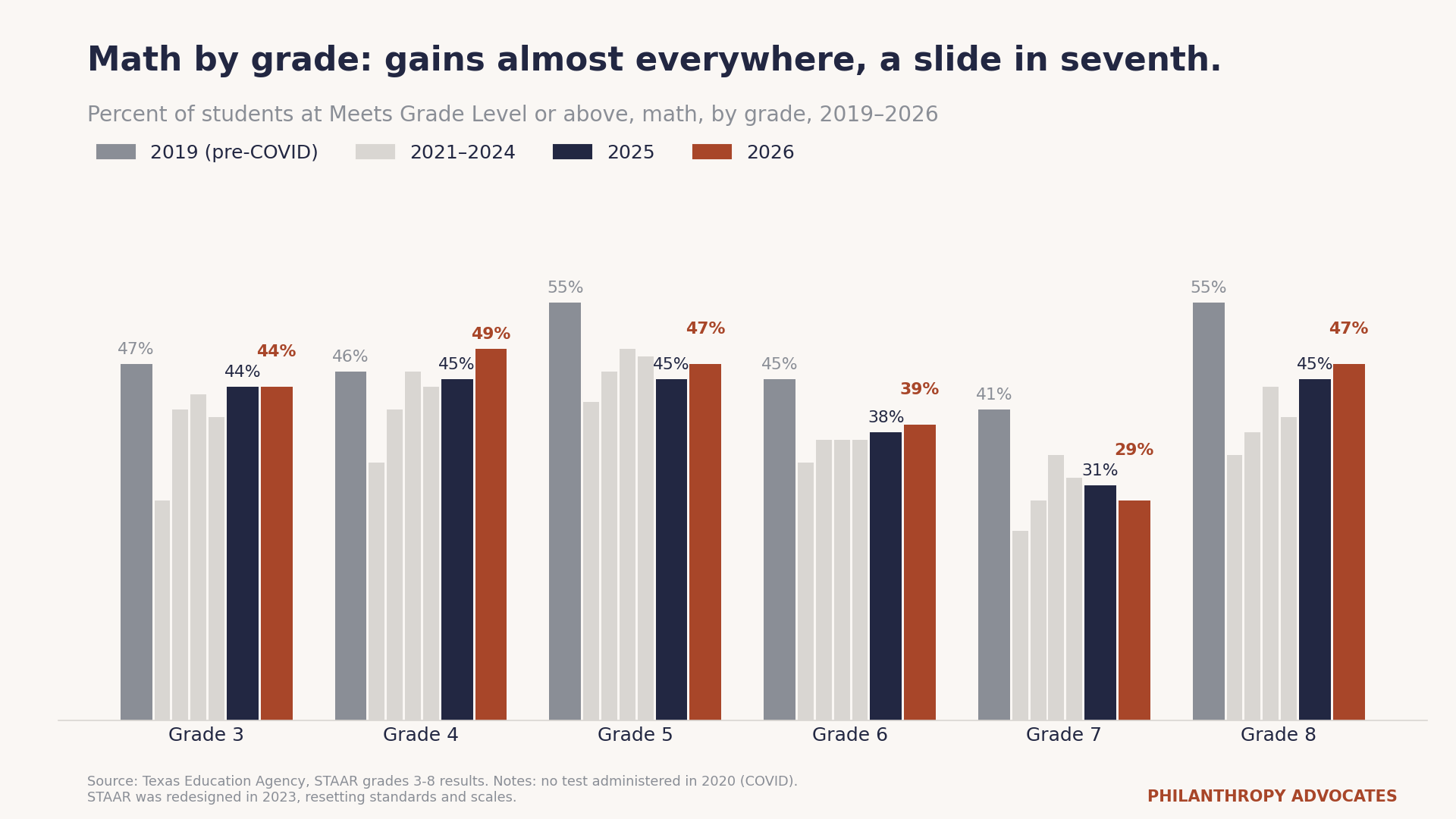
The seventh-grade results need context because this is partly a story about who takes the test. Texas has rapidly expanded advanced math pathways that move high-achieving students through middle school math early. Students on that pathway typically take the grade 8 STAAR while enrolled in seventh grade and the Algebra I end-of-course exam while enrolled in eighth grade, which removes many of the strongest math students from the grade 7 testing pool. That shift means the grade 7 line increasingly understates how seventh graders as a whole are performing, and it is one reason middle school math should be read alongside the Algebra I results released last week. At the same time, acceleration for some students cannot become the whole story. The state must keep supporting students who are not on the accelerated pathway so that every student builds the math foundation needed to successfully pursue the careers they want and be on a path of lifelong economic mobility.
Reading scores hold their high ground, with soft spots
Fifty-four percent of students met grade level in reading language arts, holding at the highest level since at least 2019 and 9 points above the pre-COVID mark of 45 percent. Reading scores first crossed pre-pandemic levels in 2022 and have stayed above every year since.
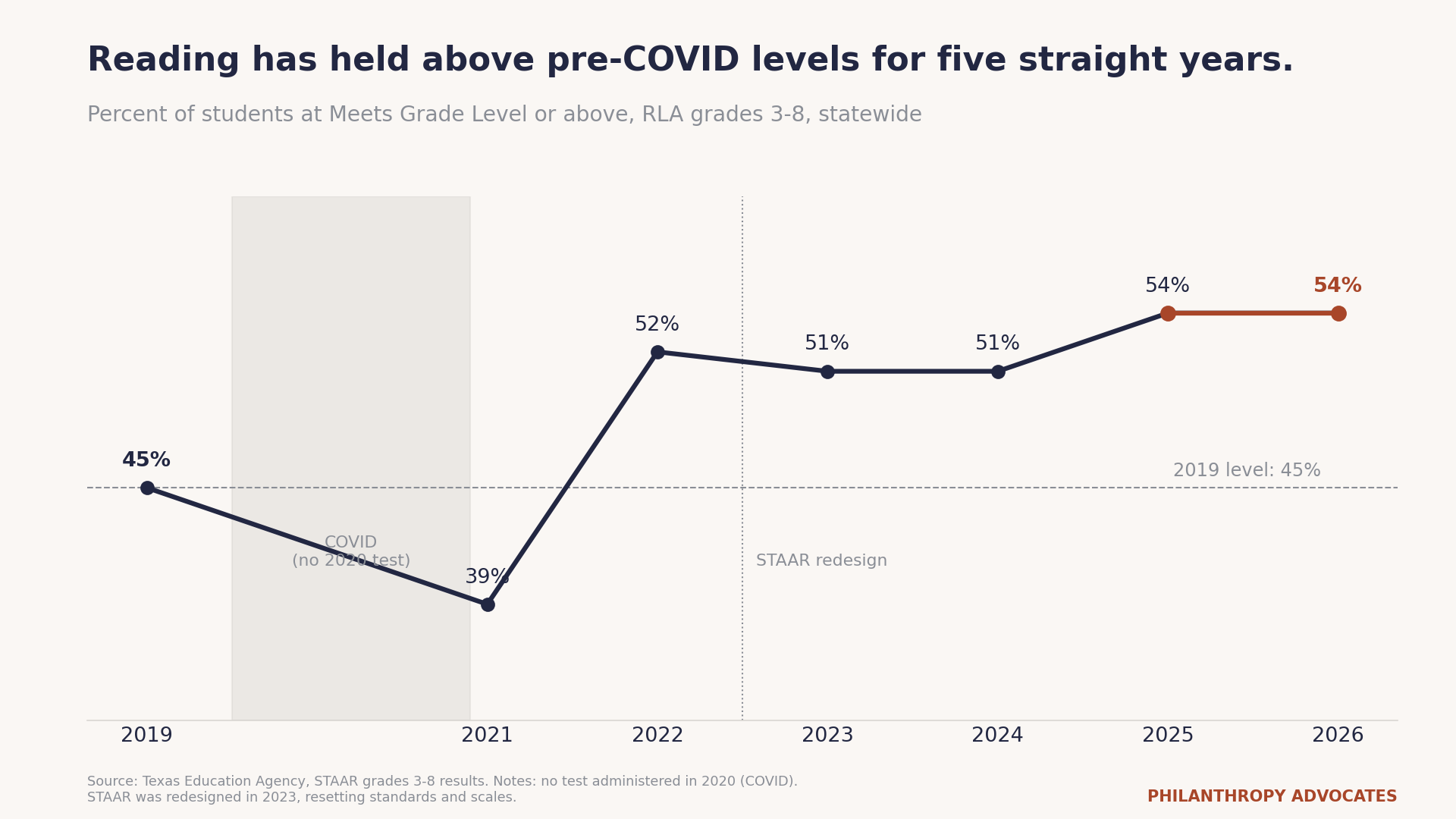
The flat statewide number conceals movement in both directions. Eighth grade led the way, gaining 3 points to reach 59 percent, a new high since at least 2019, and seventh grade rose 2 points to 54 percent, matching its best result. Grades 4 through 6 held steady at or near their highs. Third grade slipped a point to 49 percent. Third grade scores remain 6 points above their 2019 level, but early literacy underpins everything that follows, so third grade reading is the first number to check when next year’s results arrive.
Those reading results track years of deliberate state investment in literacy: House Bill 3 in 2019 built reading academies that trained kindergarten through third grade teachers in the science of teaching reading and expanded full-day pre-K, and House Bill 1605 in 2023 funded high-quality instructional materials. Districts are still early in adopting those materials, so the full payoff should come with more years of implementation and the curricular coherence that follows. Reading language arts is where Texas has invested the longest, and it is the subject furthest above its pre-COVID level. House Bill 2 from 2025 further increased early literacy supports, including ensuring reading academies training for new teachers as a part of their pre-service preparation, strengthening the identification of struggling readers, and investing in intervention and tutoring, all of which will be implemented in coming years.
Science results arrive July 31
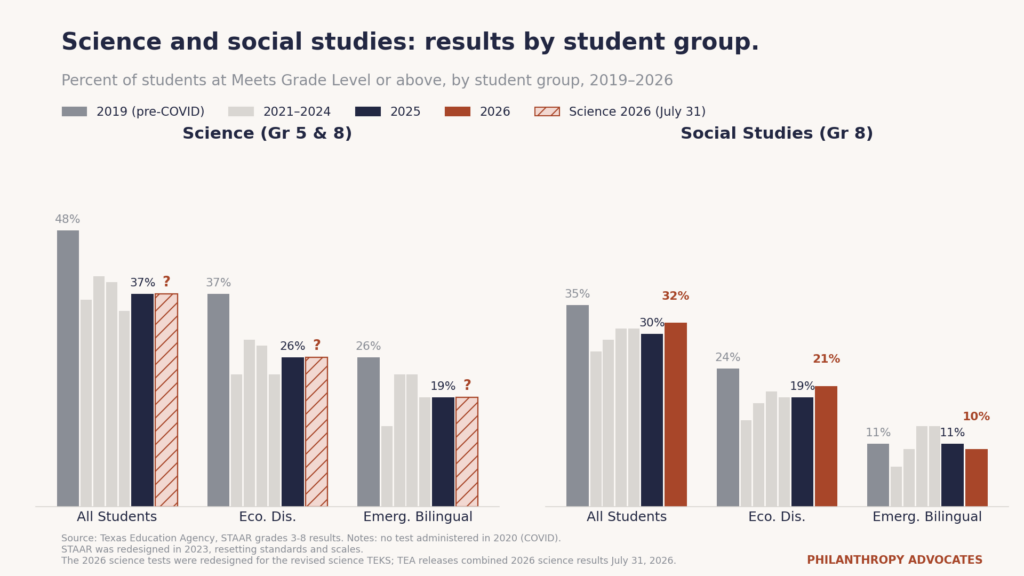
This year’s release does not include science. TEA redesigned the grades 5 and 8 science assessments for 2026 to fully assess the revised science TEKS implemented in 2024, and because new tests require standard setting, the agency will release combined science results on July 31. For context, science enters that release with the most ground to make up of any subject: 37 percent of students met grade level in 2025, 11 points below the 2019 level of 48 percent. We will update this analysis when the results arrive.
Social studies improves from a low base
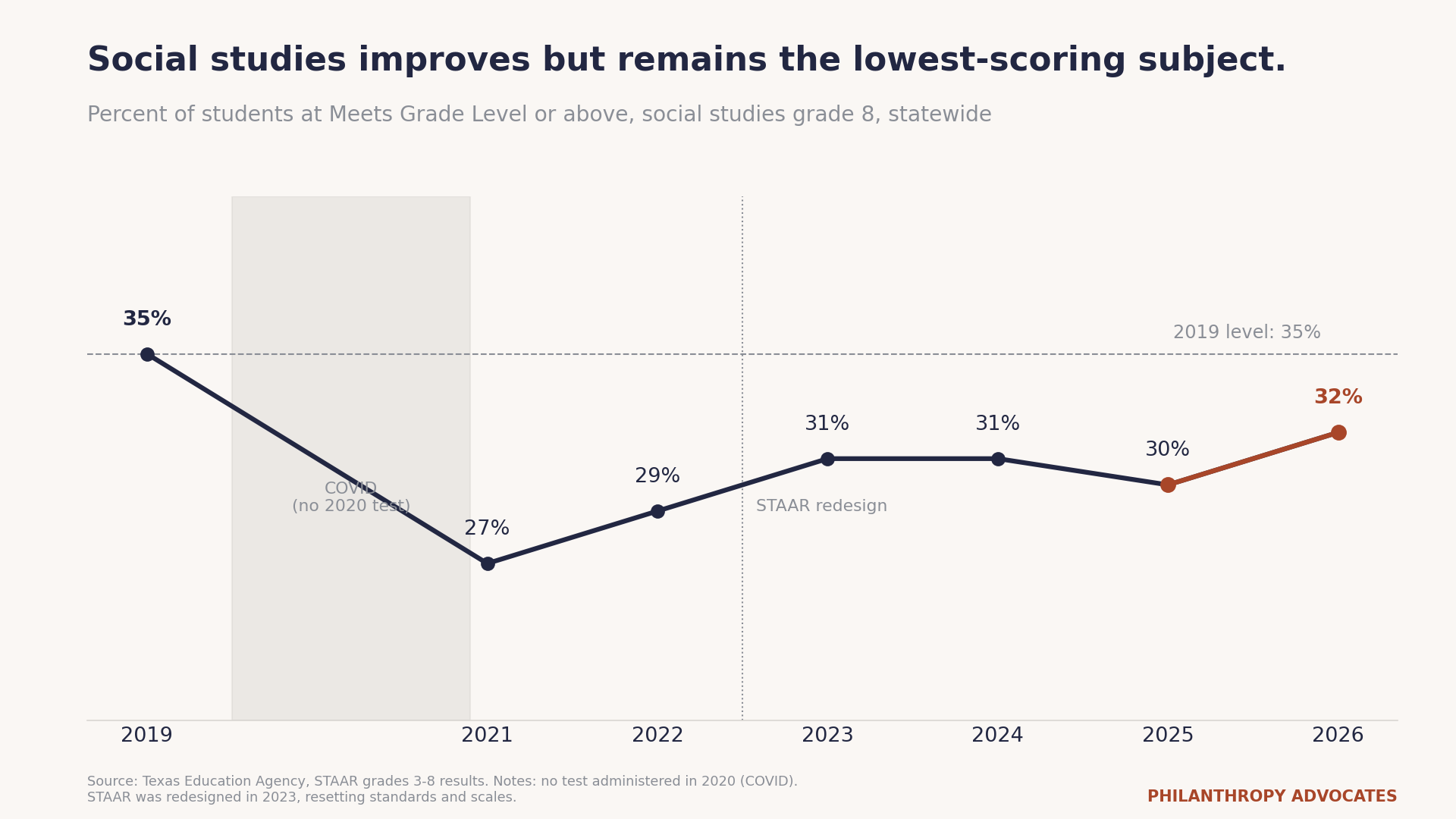
Grade 8 social studies scores, from the only social studies test in grades 3 through 8, rose 2 points to 32 percent meeting grade level. That is welcome movement, but social studies remains the lowest-performing subject the state tests, still 3 points below its 2019 level of 35 percent.
At the top of the scale, reading and math diverge
Meets Grade Level is the on-grade-level benchmark, but Masters Grade Level, which signals readiness for advanced coursework, tells its own story this year. In reading, the top end grew along with the middle: the share of students reaching Masters rose across most grades, including fifth grade at 34 percent, now above its 2019 level of 28 percent, seventh grade at 31 percent, and third grade at 24 percent. Math has not matched that. Third grade Masters rose 3 points to 22 percent, but the upper grades were flat or down, and just 9 percent of seventh graders reached Masters in math.
Progress is reaching more students, but gaps remain
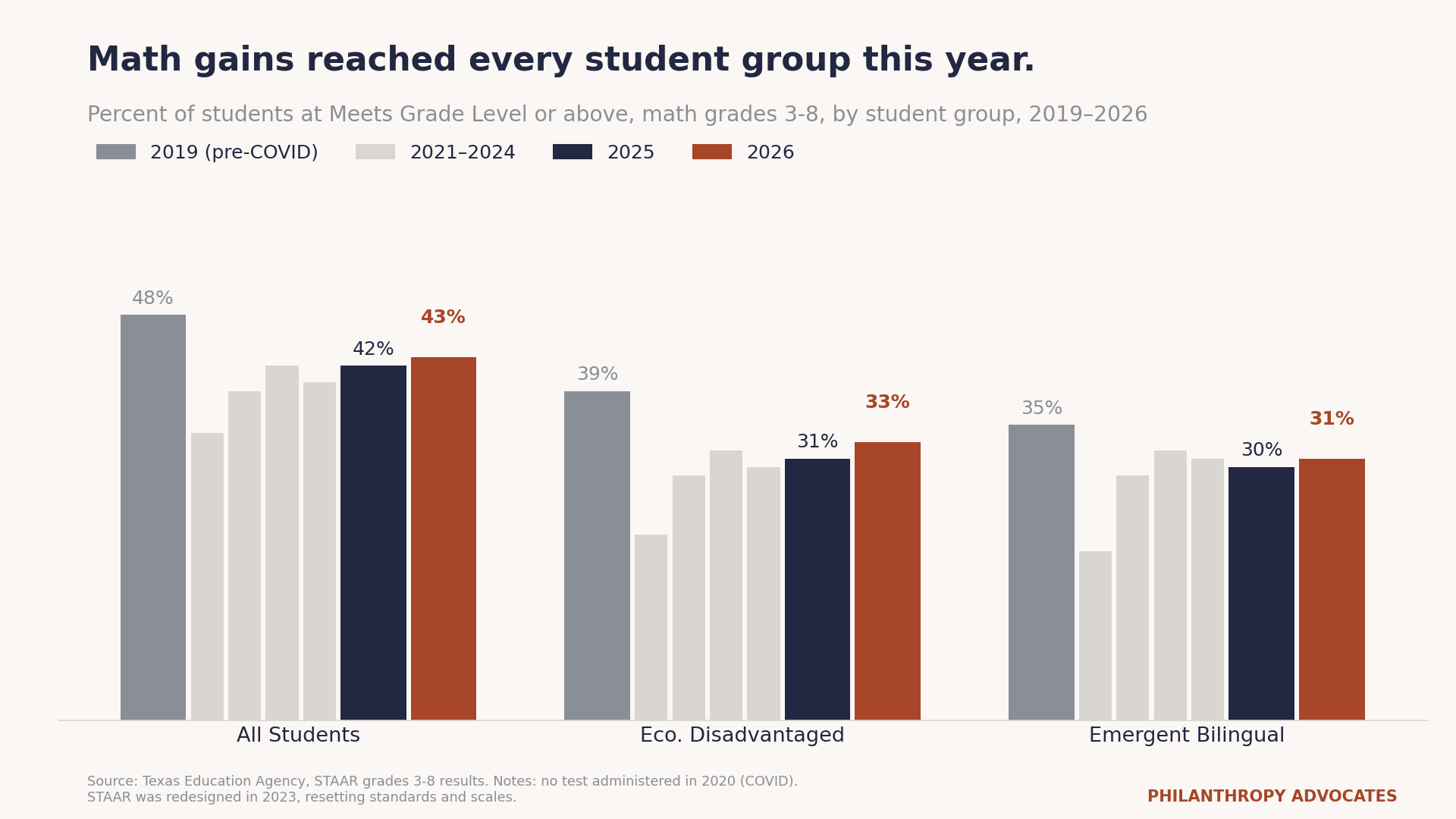
In math, every student group gained ground. Economically disadvantaged students rose 2 points to 33 percent, though that remains 6 points below their 2019 level. Emergent bilingual students gained a point to reach 31 percent, and students receiving special education services rose to 17 percent, above their 2019 level for a new high since at least 2019.
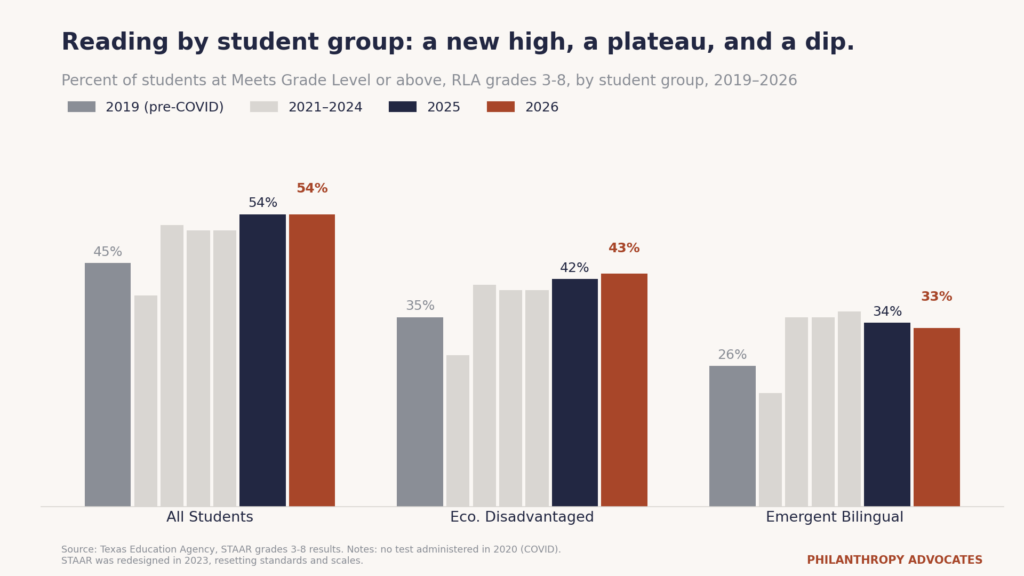
In reading, the group results point in different directions. Economically disadvantaged students reached 43 percent, a new high since at least 2019 and 8 points above their pre-COVID level. Students receiving special education services held at 19 percent, matching their high. Emergent bilingual students slipped a point to 33 percent, still 7 points above 2019 but a second straight year of decline from their 2024 high of 36 percent.
Science results by student group will arrive with the July 31 release. In grade 8 social studies, economically disadvantaged students gained 2 points to reach 21 percent, though that remains 3 points below their 2019 level. Emergent bilingual students slipped to 10 percent and students receiving special education services held at 9 percent, numbers that have barely moved since 2019.
Across race and ethnicity, Hispanic students gained 2 points in both math (37 percent) and reading (48 percent, their best since at least 2019), and African American students gained a point in each, reaching 29 percent in math and a best-since-2019 result of 44 percent in reading. With White students slipping a point in reading, the gaps narrowed modestly this year.
At the same time, the results measure the distance between where Texas stands and the promise the state makes to every student and family: a public education that puts every child on grade level and on a path to opportunity. Fewer than 1 in 3 seventh graders who took the seventh-grade assessment meet grade level in math. One in 10 emergent bilingual students meets grade level in grade 8 social studies. Students receiving special education services remain below 20 percent in every subject.
A baseline year for the state’s next big investment
Over the past several sessions, the Legislature has made sustained, deliberate investments in the foundational subjects: reading academies and expanded pre-K in House Bill 3, high-quality instructional materials in House Bill 1605, and now House Bill 2, the $8.5 billion package passed in 2025 that raises teacher pay, invests in teacher preparation and retention strategies, including phasing out uncertified teachers in foundation grades and subjects, and invests $648 million in early literacy and numeracy, including new math achievement academies modeled on the reading playbook, screeners to identify struggling students earlier, and literacy interventions. Those HB 2 supports are just beginning to reach classrooms, which makes this year the baseline against which their impact will be measured.
Reading shows what sustained, evidence-aligned investment can produce. Math is where the state has now committed the resources to apply the same approach, and the years ahead will show whether it pays off the same way. Philanthropy Advocates will continue tracking these results, including the July 31 science release and the final end-of-course data later this summer, and sharing what the evidence means for education policy in Texas. District and campus results are available through the Texas Assessment Research Portal.