This week, the Texas Education Agency released results from the spring 2026 STAAR end-of-course assessments, and the news is encouraging. The share of students meeting grade level rose on all five exams, marking the strongest single-year improvement Texas high school students have posted since the pandemic. These assessments, taken in Algebra I, Biology, English I, English II, and US History, are the state’s most consistent (and final) measure of how students are progressing in the foundational subjects.
Key Takeaways
- For the first time since testing resumed after COVID, Texas students improved on all five STAAR end-of-course exams in the same year.
- Algebra I posted the largest single-year math gain since the pandemic, rising 7 points to 54 percent meeting grade level, marking the first time more than half of students have scored “Meets” since 2019, though still 8 points below pre-COVID performance.
- Biology rose 9 points to 71 percent, and English I (55 percent) and English II (60 percent) increased by 4 points, with all three well above pre-COVID levels of performance.
- The gains reached the students facing the steepest barriers: economically disadvantaged students, emergent bilingual students, and students receiving special education services saw growth across all subjects. The percent of emergent bilingual students meeting grade level in US History and Biology reached record highs, and economically disadvantaged students recorded and 7-point increase in grade-level performance in Algebra I.
- Work remains: Algebra I and US History are still below pre-COVID marks, fewer than half of economically disadvantaged students meet grade level in Algebra I, and just over a quarter of emergent bilingual students do so in English I and II.
The results at a glance
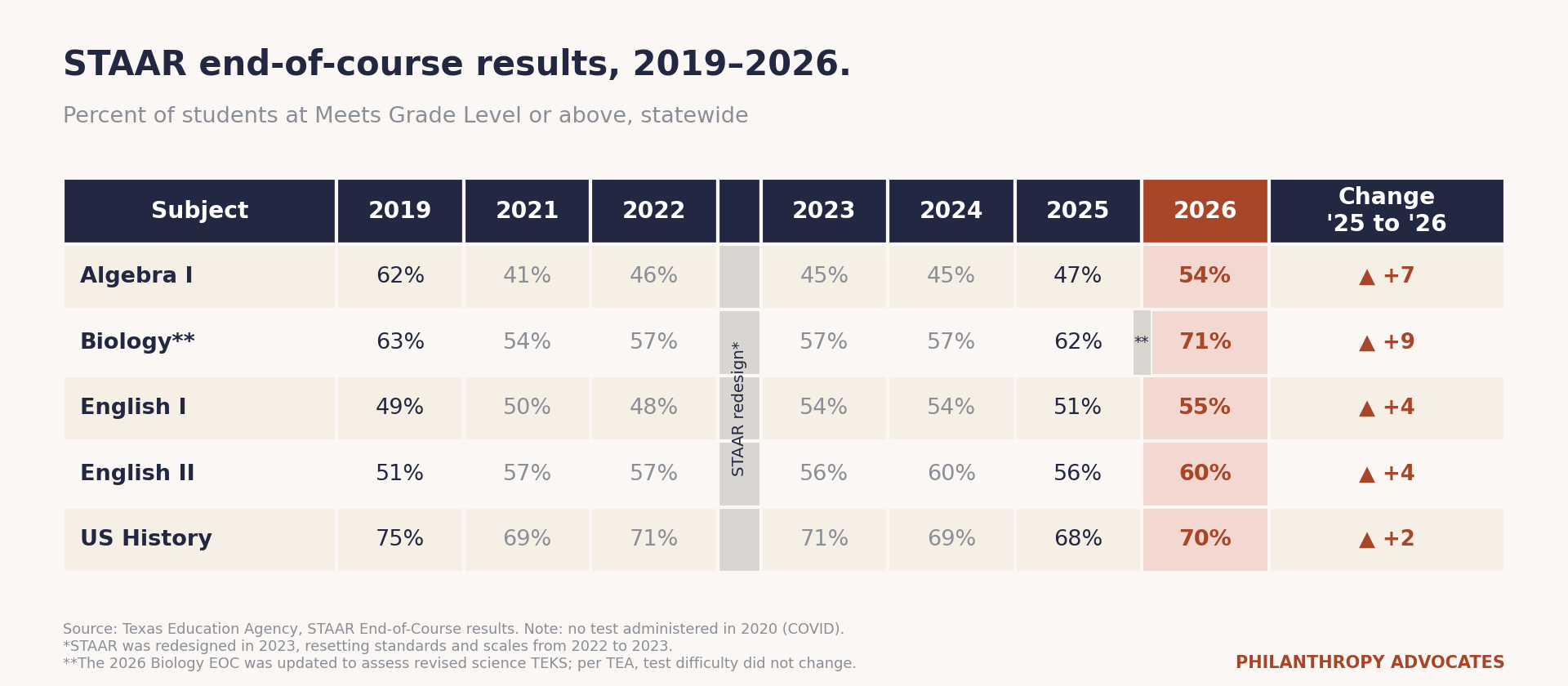
Three things stand out. This is the first year since testing resumed that all five exams improved at once. Math posted its largest single-year gain since the pandemic. And three of the five exams, Biology, which posted the largest increase of all the subjects, English I, and English II, now sit above their pre-COVID levels.
Math is moving in the right direction
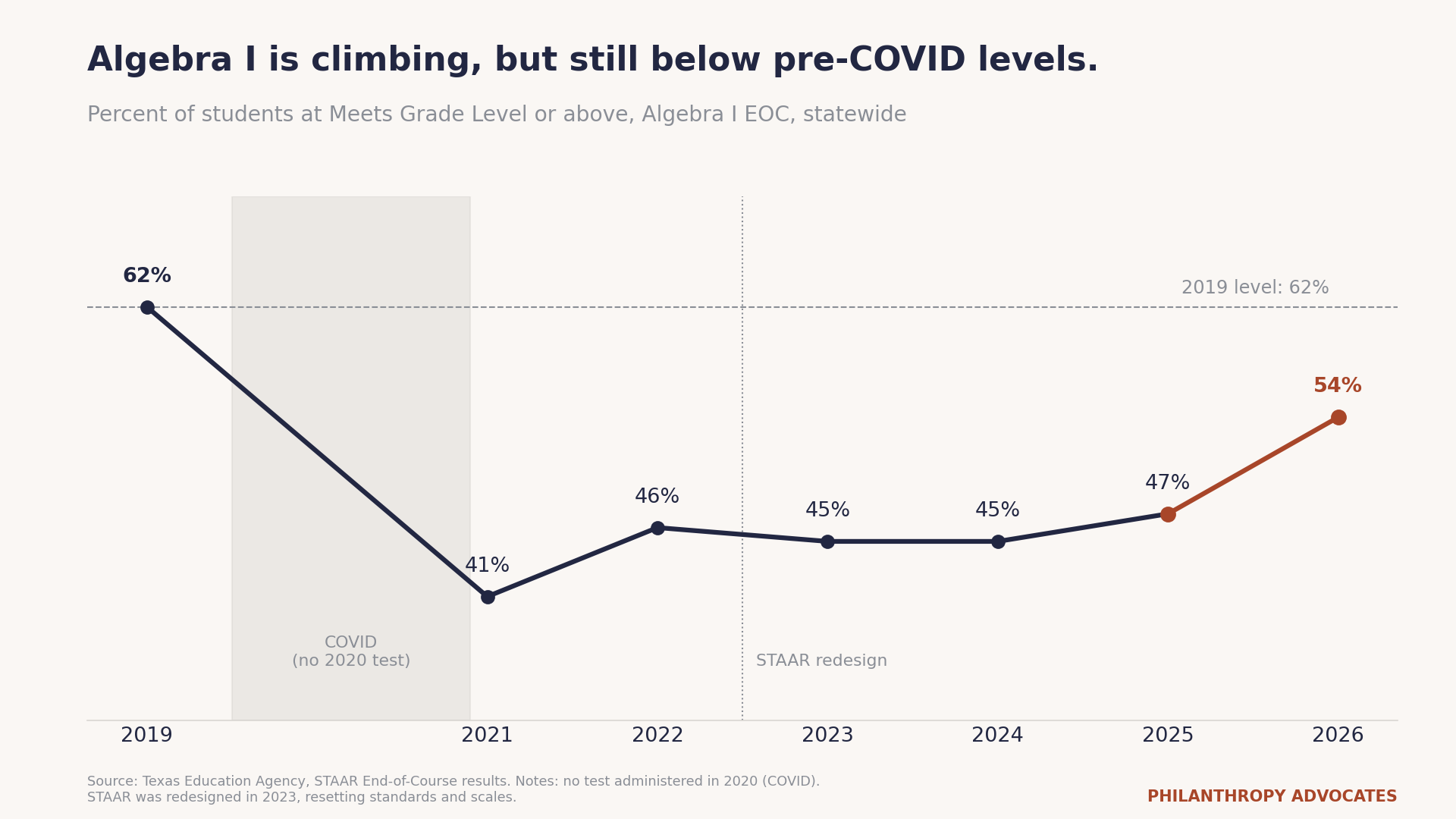
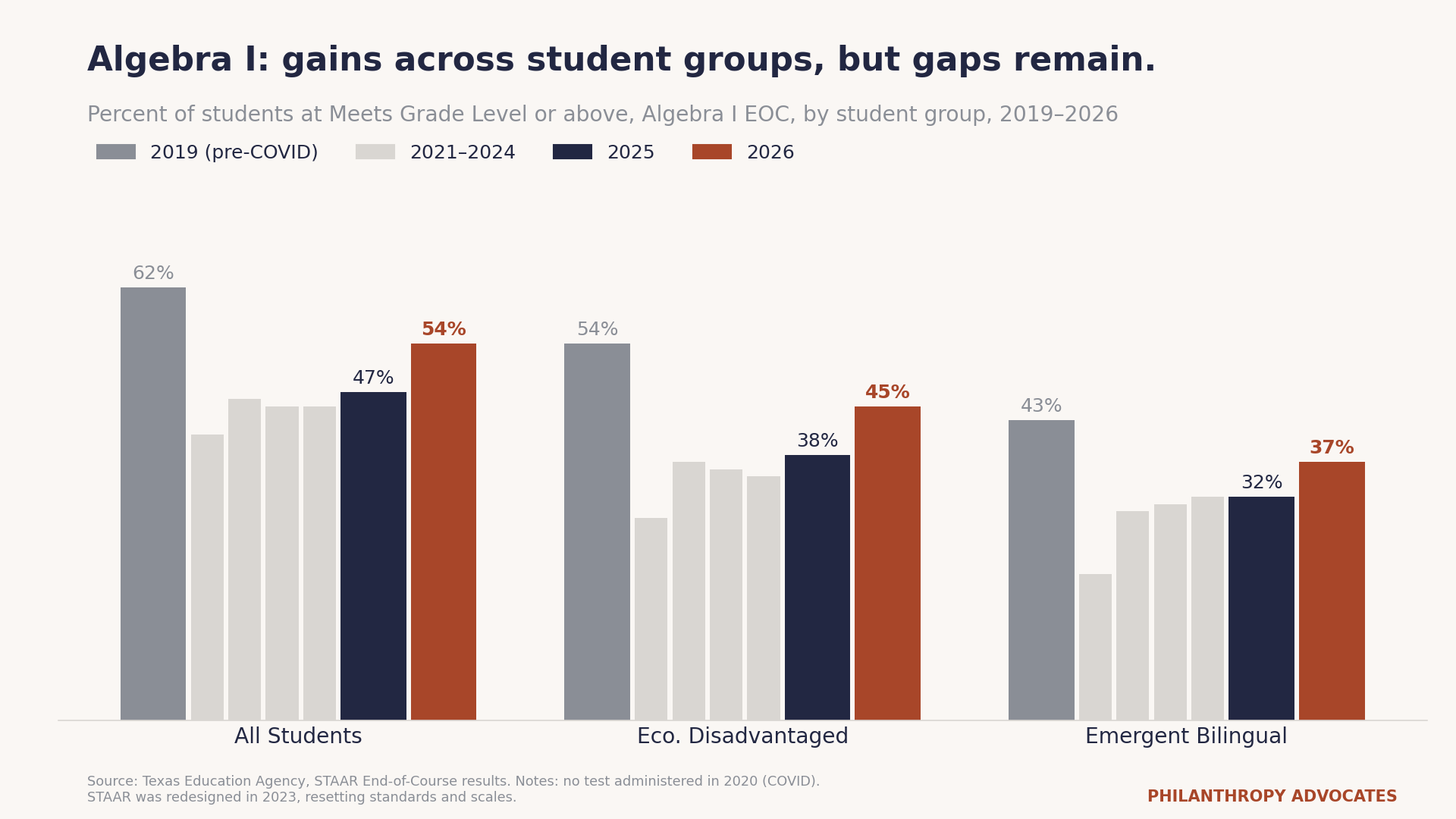
Algebra I posted a 7-point gain, with 54 percent of students now meeting grade level, up from 47 percent last year. Math has been the slowest subject to recover from pandemic-era learning loss, which makes this year’s jump particularly meaningful. Even so, Algebra I remains 8 points below the 2019 pre-COVID level of 62 percent. With more than half of students meeting grade level in Algebra 1 for the first time since before COVID, Texas has reached an important milestone in recovery more than 5 years later. Still, there is significant progress needed to ensure that all Texas students have the foundational math skills needed to succeed in college, the workforce, and life after high school.
English scores reach new heights
English I and English II each rose 4 points, to 55 percent and 60 percent respectively, and continue to climb well above pre-pandemic levels.
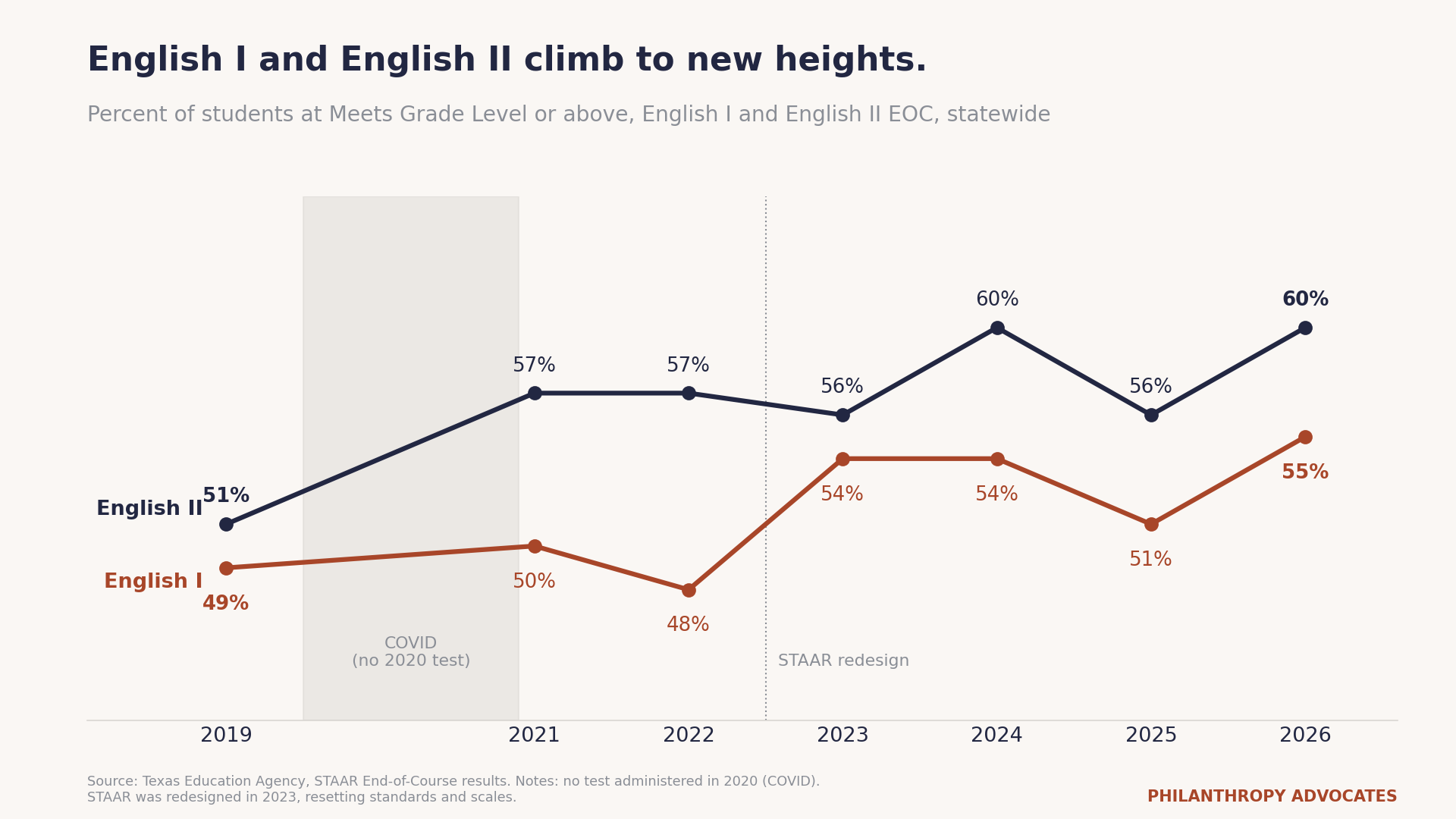
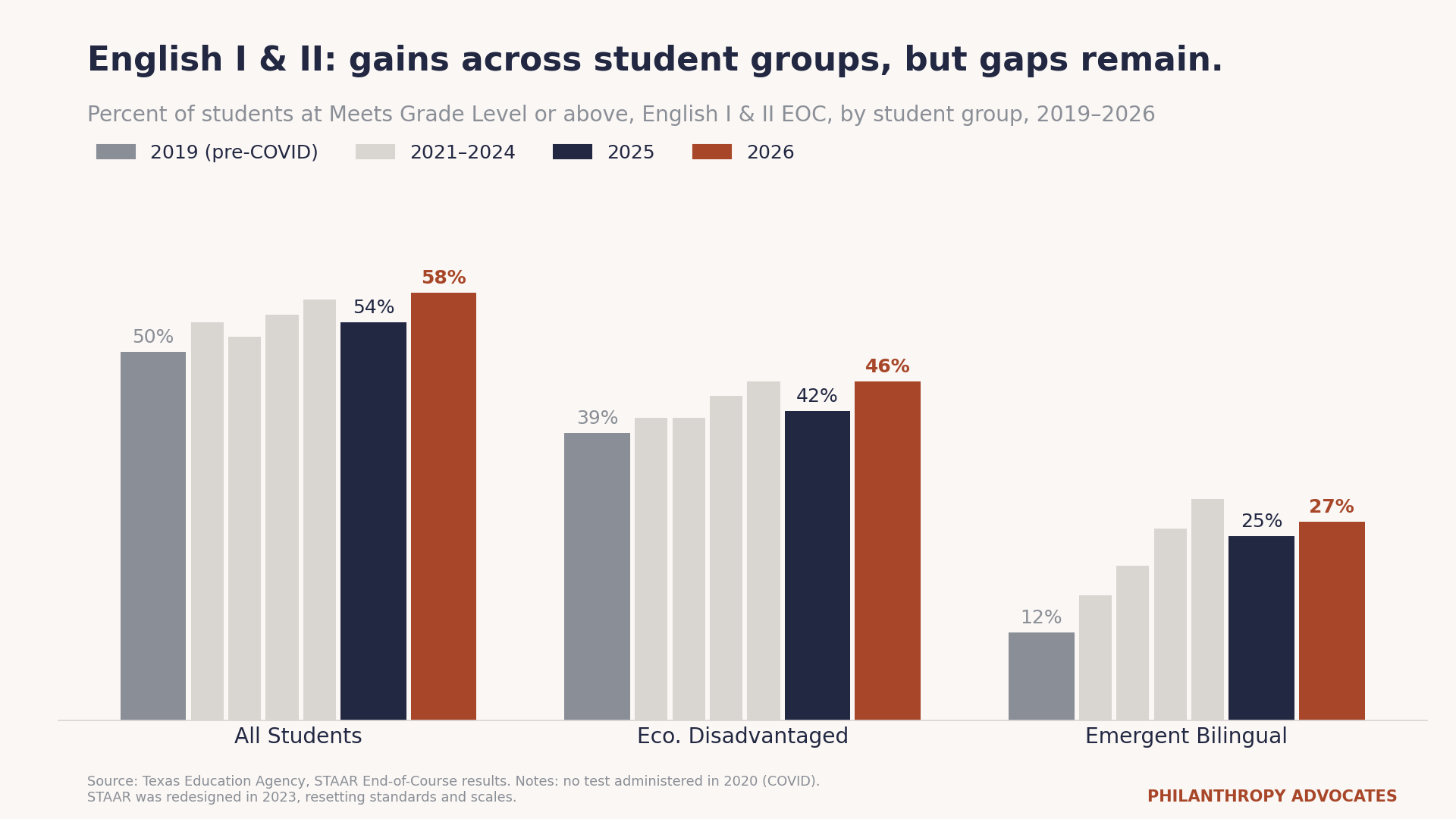
These results set new marks. English I, at 55 percent, is the highest level recorded since at least 2019, and the combined English I and II rate of 58 percent is also a new high. The gains reached students across groups: Hispanic students (50 percent) and African American students (48 percent) each posted their best combined English performance since at least 2019, and economically disadvantaged students matched their 2024 high of 46 percent.
One trend worth watching sits beneath the headline numbers: the English gains are coming at the Meets Grade Level standard rather than at the top. The share of students reaching Masters Grade Level in English I slipped from 17 percent in 2024 to 13 percent this year, and English II Masters performance has hovered near 9 percent since 2019. Texas is moving more students over the proficiency bar; the next challenge is growing the share who excel.
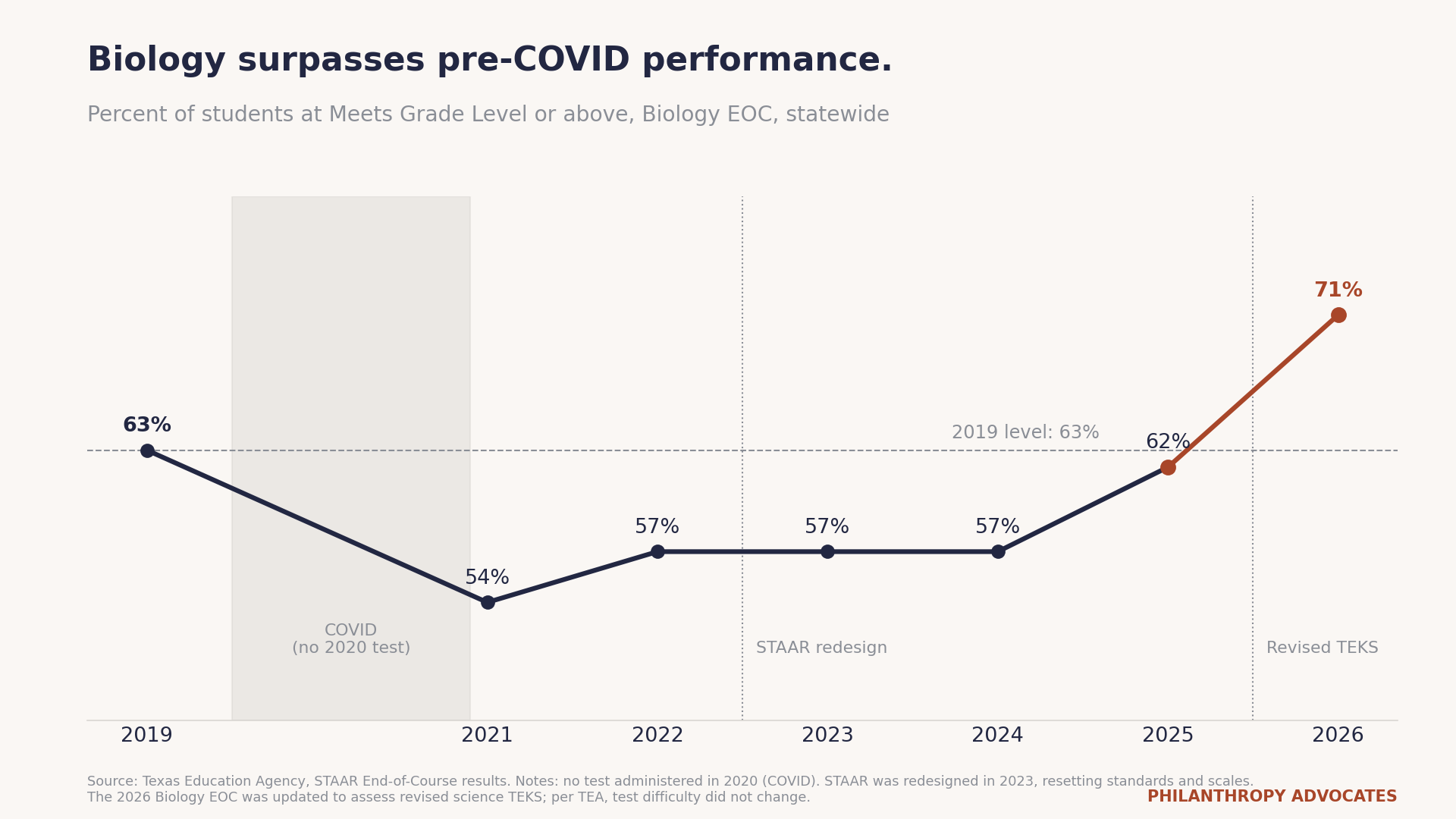
With a new test reflecting the updated TEKS, Biology saw the largest increase in students meeting grade level.
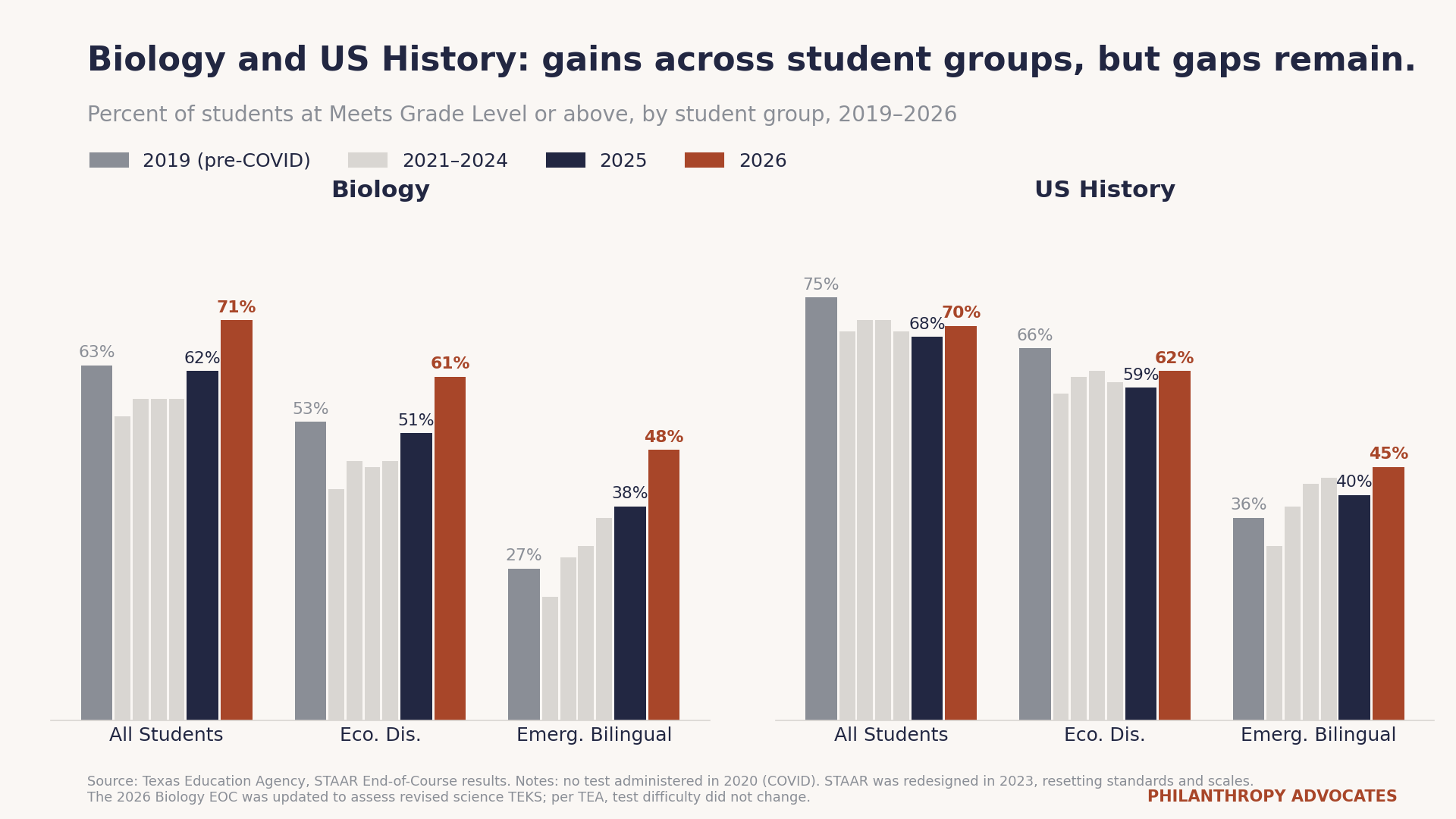
Biology saw the largest gain of any exam, rising 9 points to 71 percent and surpassing its pre-COVID level. One note of context: TEA updated the Biology EOC this year to assess the revised science TEKS implemented in 2024. The agency reports that test difficulty did not change, but the content update is worth keeping in mind when comparing results across years.
US History holds steady
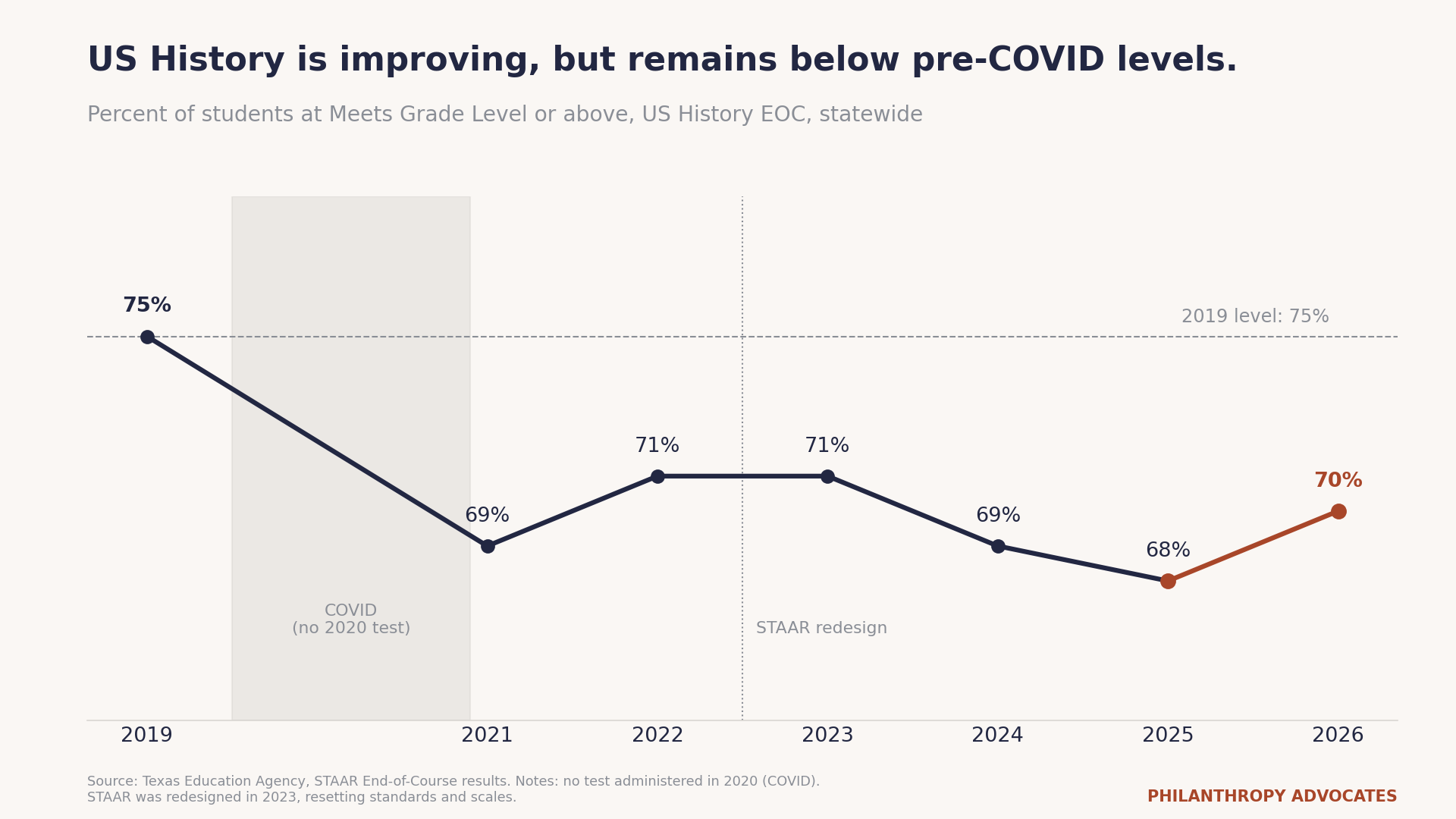
US History showed modest improvement, with 70 percent of students meeting grade level, up 2 points from last year. But it is also a reminder of unfinished business: performance is still 5 points below the 2019 level of 75 percent, making US History and Algebra I the only two exams that have not yet returned to their pre-COVID marks.
A look beyond proficiency
First, a quick note on what these labels mean. STAAR reports performance at three levels. Approaches Grade Level means a student shows some understanding of the material but may be missing critical pieces; however, it is the standard for passing the test. Meets Grade Level signals a strong grasp of the content and a high likelihood of success in the next course, which is why Philanthropy Advocates and most education analysts treat it as the benchmark for being on grade level, and why it is the number reported throughout this piece. Masters Grade Level means a student has fully mastered the material and is positioned to succeed in advanced coursework. The top of the distribution deserves attention too.
Beneath the Meets Grade Level headlines, the picture at the top is more mixed. The share of students reaching Masters Grade Level in Biology jumped from 21 to 35 percent, the highest level since at least 2019. But Algebra I Masters, at 30 percent, remains well below its 2019 level of 39 percent, and US History Masters has held at 37 percent for three straight years, 10 points below pre-COVID.
Progress is reaching more students, but gaps remain
Most encouraging, this year’s gains extended to the students who have historically faced the steepest barriers. In Algebra I, economically disadvantaged students gained 7 points, rising from 38 to 45 percent, emergent bilingual students gained 5 points, from 32 to 37 percent, and students receiving special education services reached a new high of 22 percent.
In English I and II, economically disadvantaged students reached 46 percent, matching their 2024 high. Emergent bilingual students rose to 27 percent, up 2 points from last year and more than double their 2019 rate of 12 percent, though still below their 2024 high of 30 percent. Students receiving special education services reached 19 percent, a new high since at least 2019 and up from 9 percent before COVID.
Biology and US History tell the same story. In Biology, economically disadvantaged students rose 10 points to 61 percent and emergent bilingual students climbed 10 points to 48 percent, new highs for both groups since at least 2019, while students receiving special education services jumped 10 points to 36 percent. In US History, emergent bilingual students posted their best performance since at least 2019, at 45 percent, and economically disadvantaged students improved to 62 percent.
The same pattern shows up across race and ethnicity. African American students gained 8 points in Algebra I, from 35 to 43 percent, and Hispanic students gained 8 points, from 41 to 49 percent, both outpacing the statewide gain. In English I and II, Hispanic students (50 percent) and African American students (48 percent) each reached their best performance since at least 2019.
At the same time, the results underscore how far Texas still has to go. Fewer than half of economically disadvantaged students meet grade level in Algebra I, compared to 54 percent statewide. Roughly one in four emergent bilingual students meets grade level in English I and II. Until those gaps close, too many of the 5.5 million students in Texas public schools will be left short of the opportunities they deserve.
What comes next
These results arrive at a pivotal moment for Texas. The state is implementing historic investments in public education, and House Bill 8 (89(2)) will replace STAAR with the Student Success Tool beginning in the 2027-28 school year. This year’s results show the system is capable of meaningful progress. The challenge for policymakers, educators, and philanthropy is to sustain that momentum and ensure it reaches every student.
Philanthropy Advocates will continue to track these results, as well as the STAAR 3-8 scores being released next week and share what the evidence means for education policy in Texas. District and campus level results are available through the Texas Assessment Research Portal.
Find Philanthropy Advocates’ full analysis of the STAAR EOC results here.